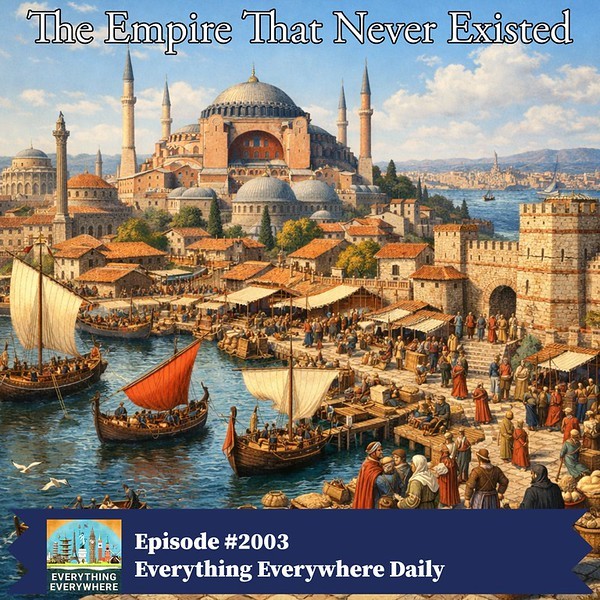
For over a thousand years, an empire flourished in the Eastern Mediterranean, leaving behind a legacy of art, law, and religious influence. Yet, despite its enduring impact, the empire was never called “Byzantine” by its own people. The term is a modern invention, a Western construct imposed centuries after its fall. This episode explores why the historical record reveals that this empire was, in its own time, simply the continuation of the Roman Empire.
The Roman Identity
The empire’s heart was Constantinople (modern Istanbul), and its people consistently identified as Romans. From Emperor Justinian’s reign in 555 – when the empire controlled vast territories around the Mediterranean – to its final collapse in 1453, rulers and citizens alike used the term Rhomaioi to describe themselves. Their emperors held the title Basileus ton Rhomaion, meaning “Emperor of the Romans,” and their state was the Basileia ton Rhomaion, or “Empire of the Romans.”
This wasn’t merely a matter of semantics. The continuity between the ancient Roman Empire and its eastern successor was deliberate and unbroken. Emperors traced their legitimacy back to Augustus, Julius Caesar, and the Roman Republic. Even when the Western Roman Empire fell in 476, the Eastern half continued with minimal disruption, with barbarian rulers like Flavius Odoacer recognizing the authority of the emperor in Constantinople.
The Tetrarchy and the Split
The roots of this distinction lie in the late third century when Emperor Diocletian divided the Roman Empire into East and West to improve administration. This division became permanent after Constantine I (Constantine the Great) established Constantinople as a “New Rome,” further solidifying the empire’s eastern identity. Subsequent splits and attempts at reunification occurred, but the core Roman structure endured.
The Invention of “Byzantine”
The term “Byzantine” emerged centuries later, in the 16th century, thanks to Western European scholars. German historian Hieronymus Wolf formalized the label in his 1557 Corpus Historiae Byzantinae. This was partly to differentiate the Eastern Roman Empire from the ancient Roman Empire and partly due to negative Western perceptions that framed the East as decadent or overly bureaucratic. Over time, “Byzantine” became entrenched in academic writing.
Modern Usage and Legacy
Today, scholars use “Byzantine Empire” as a convenient shorthand, acknowledging it’s an external designation. The empire’s own people never used it. Even the modern nation of Romania derives its name from România, the term the empire’s inhabitants used to describe their land.
The story of the “Byzantine Empire” is a reminder that history is often filtered through the lens of those who write it. The empire that never called itself Byzantine was, in reality, just Rome… continuing.