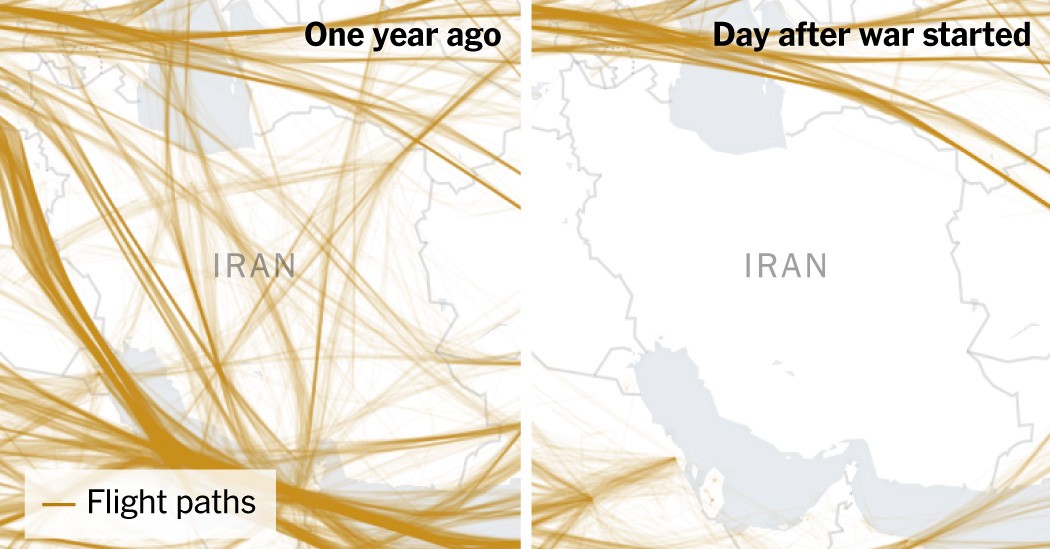
The ongoing conflict involving Iran has triggered widespread flight diversions and cancellations across the Middle East, significantly impacting international air travel. Airlines are forced to reroute flights, adding fuel consumption, raising fares, and increasing flight times as airspace over Iran and surrounding countries remains restricted.
Escalating Restrictions and Historical Precedents
This disruption is not isolated. The aviation industry has faced similar challenges in recent years, most notably following Russia’s 2022 invasion of Ukraine. That conflict closed a critical flight corridor in Northern Europe, forcing airlines to take longer southern routes or even fly over the North Pole. Now, the Middle East conflict is compounding these issues, fragmenting what was once an efficient global aviation network.
Rerouting and Increased Costs
Before the current conflict, flights between Europe and Asia frequently used the “Siberian Corridor” over Russia, offering a direct route. After Russia banned Western airlines from its airspace, flights were rerouted, adding hours to travel times. For example, a Helsinki-Tokyo flight that once took nine hours now takes over twelve, depending on whether it flies south around the Black Sea or north over the Arctic.
Similarly, flights to Bangkok from Helsinki were forced to take detours through the Middle East, adding an hour to the original flight duration. With the latest fighting, airlines such as Finnair have once again had to reroute flights, further illustrating the industry’s vulnerability to geopolitical instability.
Reduced Capacity and Gradual Recovery
Commercial flight traffic in the Persian Gulf region remains substantially below normal levels. Airspace in and around Iran, Iraq, Syria, Bahrain, and Qatar is largely empty of civilian planes. While some airports are beginning to see a slow return of traffic—Dubai International Airport reported over 500 departures and landings on Sunday, a week after peak cancellations—it still operates far below its typical capacity of around 1,200 flights per day.
The interconnectedness of global air travel makes it highly susceptible to regional conflicts. Disruptions in one area quickly ripple across the world, forcing airlines and passengers to adapt to higher costs, longer journeys, and increased uncertainty.