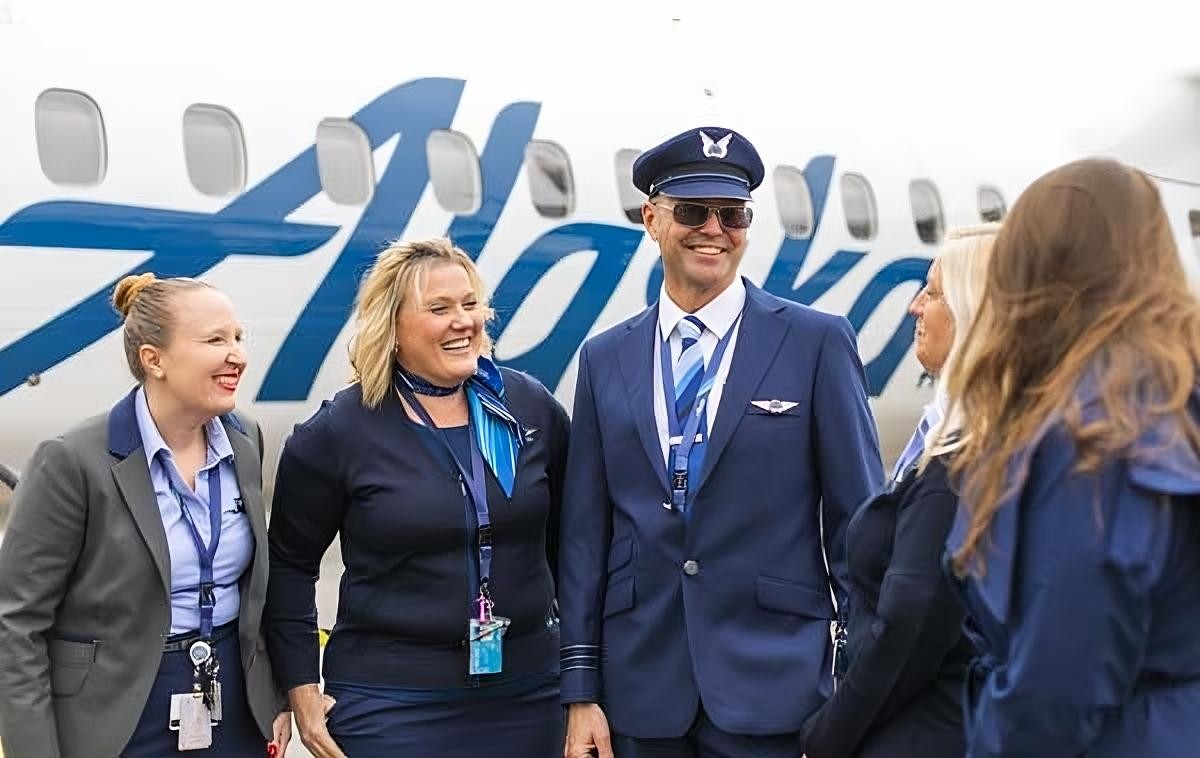
A recent incident involving an Alaska Airlines flight attendant has reignited the debate over where personal political expression ends and professional duty begins. After a crew member was photographed wearing an “ICE OUT” pin—a slogan protesting Trump administration immigration enforcement—questions have surfaced regarding airline policies, passenger comfort, and the ethics of power dynamics in the cabin.
The Policy Conflict
While Alaska Airlines maintains a progressive stance on certain social issues, there are clear boundaries regarding what staff can wear. The airline currently allows employees to wear pronoun pins and offers various other company-approved accessories. Furthermore, union contracts typically permit the wearing of official union insignia.
However, the “ICE OUT” pin falls into a different category. By adopting a highly charged political slogan that is not part of the company’s approved merchandise, the flight attendant bypassed established professional standards. This creates a dilemma for the airline: balancing the personal values of its staff with the need for a neutral, professional brand.
The Complexity of the Immigration Debate
The controversy highlights how deeply polarized the immigration debate has become. The issue is rarely a simple binary of “pro” or “anti” immigration; rather, it involves a complex web of competing, valid concerns:
- Economic Necessity: Many argue that legal immigration is vital to offset declining populations and prevent the fiscal crises that arise from shrinking workforces.
- Labor Needs: Guest worker programs are often viewed as a way to fill labor gaps while simultaneously reducing illegal immigration by providing legal pathways.
- Enforcement and Sustainability: Conversely, there is a growing political consensus—not just in the U.S. but across Europe—that current levels of undocumented immigration are politically and socially unsustainable.
Because the topic is so nuanced, reducing it to a single slogan like “ICE OUT” ignores the legitimate arguments on all sides, including calls for reform in how enforcement is conducted (such as requiring judicial warrants or protecting access to schools and hospitals).
The Problem of Asymmetric Speech
Beyond the political merits of the slogan, the incident raises a critical point about the power dynamic between crew members and passengers. In an airplane cabin, communication is inherently asymmetric:
- Forced Audience: Unlike a public protest where people can choose to walk away, passengers in a confined cabin are a “captive audience.” They are required to interact with the crew for their safety and service.
- Risk of Escalation: When a crew member uses their position to engage in political proselytizing, it can create tension. If a passenger attempts to respond or argue, the situation can quickly escalate into a conflict that requires law enforcement intervention.
- Brand Impact: For the airline, having uniformed staff express polarizing views risks alienating large segments of the customer base, potentially damaging the brand’s reputation for neutrality and service.
Conclusion
While the underlying sentiments regarding immigration enforcement may be rooted in genuine concern, wearing political slogans while in uniform blurs the line between personal activism and professional service. Ultimately, the airplane cabin is a space where neutrality is essential to maintaining safety, order, and a welcoming environment for all travelers.