


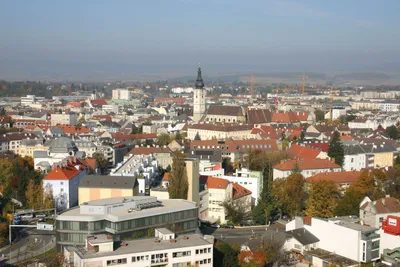
Sankt Pölten sits in the shadow of its giant neighbor, Vienna, but it is hardly a ghost town. Located in northeastern Austria, this city serves as the capital of Niederösterreich. It rests along the Traisen River, nestled between the Danube and the foothills of the Alps. For travelers looking for a historic Austrian city capital, this spot offers a distinct alternative to the tourist-heavy centers further east.
The name itself is a linguistic fossil. It developed around an 8th-century abbey dedicated to St. Hippolytus. Over time, the Germanicized version of the saint’s name stuck. Before that, it was the Roman settlement of Aelium Cetium. The bishops of Passau, now in Germany, held power here until 1490. The city received its charter in 1159. It didn’t become an episcopal see until 1785, a long time for a town to wait for recognition.
Architecture That Tells a Story
You can walk through the old town and see layers of history. The cathedral started as the abbey church. The town hall is a Renaissance structure. Both were remodeled in the 18th century, giving them that distinct Central European sheen. Look for the Prandtauer church. It was designed by Jakob Prandtauer, a local architect who lived from 1660 to 1726. He also designed the convent of the Institut der Englischen Fräulein.
The episcopal palace stands as a reminder of the 17th century, built between 1636 and 1653. The Franciscan church, completed between 1757 and 1768, adds to the skyline. If you venture out to nearby Herzogenburg, you’ll find an Augustinian abbey that adds to the region’s religious heritage.
A Modern Administrative Hub
Despite the old stone walls, Sankt Pölten is not stuck in the past. It is an important rail junction. Goods and people move through it constantly. It serves as a market center for the surrounding countryside. There is also a manufacturing industry here, keeping the local economy grounded.
In 1986, the city made a bold move. It was chosen to replace Vienna as the state capital. This decision changed the urban fabric. Modern government buildings now contrast with the historic townscape. It is a visual clash that works. Many government employees live elsewhere in the state. They commute to Sankt Pölten for work, which keeps the city active during the day.
Practical Details for Your Trip
The population was recorded at 51,068 in 2006. It is small enough to walk, but large enough to have amenities. The location is strategic. You are west of Vienna, but close enough to Vienna to catch a train if you need more metro energy. The Traisen River provides a scenic backdrop for evening walks.
The blend of Roman roots, medieval abbey life, and modern administrative function makes Sankt Pölten unique. It is not just a stopover. It is a destination with its own rhythm. The architecture tells you where you are. The rail links tell you where you can


