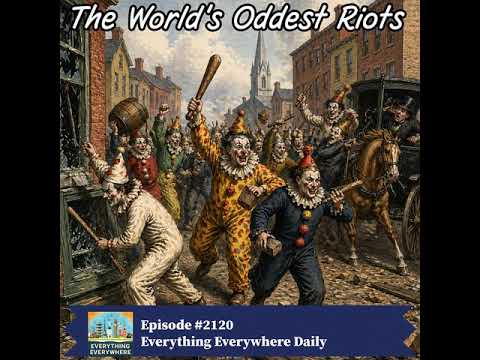
While most historical uprisings are fueled by heavy themes like political oppression, poverty, or religious conflict, history also holds a collection of much stranger eruptions. There have been moments when violence broke out not because of a systemic injustice, but because of something as trivial as a fashion faux pas, a misunderstanding at a bar, or a disappointing spectacle.
These “absurd” riots reveal a fundamental truth about human nature: once a crowd reaches a certain level of tension, it often requires only the smallest, most illogical spark to ignite total mayhem.
The Toronto Circus Riot (1855): Clowns vs. Firefighters
In the mid-19th century, Toronto was a rough-and-tumble pioneer town characterized by a high density of taverns and brothels. In 1855, a traveling American circus—S.B. Howes’ Star Troupe—was performing in the city, drawing large crowds of spectators.
The spark for the riot was surprisingly theatrical. After their performances, a group of circus clowns visited a local brothel. Upon their arrival, they encountered members of the Hook & Ladder Firefighting Company. In this era, firefighting was not a unified government service but a collection of competing, often aggressive, private companies. The Hook & Ladder crew was known for being particularly volatile.
An argument erupted over who would occupy the establishment. In a surprising turn of events, the clowns defeated the firefighters in the ensuing brawl, leaving two firemen seriously injured.
The fallout was even more chaotic:
– The Escalation: Seeking revenge, the firefighters turned to the “Orange Men,” a powerful Protestant gang that effectively controlled Toronto’s law enforcement and politics.
– The Attack: The Orange Men descended upon the circus grounds, attacking performers with stones and breaching the site.
– The Destruction: Using axes and pikes, the mob destroyed equipment and torched the circus tents.
– The Cover-up: Because many of the rioters were members of the police or the influential Orange Men, only one person was convicted. This systemic corruption eventually became a catalyst for much-needed police reform in Toronto.
The New York Straw Hat Riots (1922): A Fashion Enforcement War
In the early 20th century, social etiquette was strictly enforced through unwritten rules. One such rule concerned straw hats. While popular for summer wear, social convention dictated that they should be retired by September 15th in favor of felt or silk hats.
Wearing a straw hat past this deadline was considered a social blunder, and a tradition of “hat-stomping” had emerged, where people would knock the hats off offenders’ heads and stomp them into the dirt. In September 1922, this tradition spiraled into several days of urban warfare in New York City.
The violence began when groups of youths, known as the “Mulberry Bend,” began aggressively attacking factory and dock workers who were still wearing summer headwear. What started as localized harassment escalated into massive street battles:
– Mob Mentality: Groups of up to 1,000 youths prowled Manhattan, hunting for anyone wearing a straw hat.
– Hospitalizations: Many men were beaten and hospitalized simply for refusing to change their attire.
– Police Complications: Law enforcement struggled to contain the riots, partly because some off-duty officers were themselves targets for wearing the “forbidden” hats.
The violence only subsided when the trend itself eventually faded from fashion.
The Leicester Balloon Riot (1864): Disappointment Turned Violent
Perhaps the most surreal of these events occurred in Leicester, England, involving a crowd of 50,000 people and a single hydrogen balloon.
In 1864, aviation was a rare and magical novelty. When balloonist Henry Coxwell prepared for a public ascent in Victoria Park, the crowd was mesmerized. However, as the crowd pressed forward to get a better view, they became dissatisfied with the size of the balloon, feeling it was smaller than advertised.
The situation devolved rapidly due to a breakdown in communication:
1. Perceived Defiance: As the crowd crowded the launch site, Coxwell struggled to prepare the craft. The onlookers misinterpreted his struggle as a refusal to launch.
2. The Deflation: In a desperate attempt to clear the crowd, Coxwell threatened to vent the hydrogen. He followed through, deflating the balloon.
3. The Outrage: Instead of calming the crowd, the deflation convinced the mob that the balloon was faulty and poor quality.
The crowd turned on Coxwell, tearing at the balloon and setting the wicker basket on fire. The event was so bizarre that the citizens of Leicester were mockingly nicknamed “Balloonatics” by neighboring towns for years to follow.
These peculiar episodes remind us that while we like to believe human behavior is driven by logic, a mob is often driven by momentum. A riot rarely needs a profound cause; it only needs a spark.