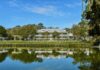
If you are driving the Calder Highway through northwest Victoria, Sea Lake looks like just another stopover. It sits about six miles south of Lake Tyrrell, a massive salt-encrusted depression that dominates the landscape. You pass through it to get to bigger things, or maybe you’re just refueling. But there is a reason this town exists, and it has little to do with the grain fields and sheep stations that currently define its economy.
The name itself is a historical typo that refused to die.
When William Edward Stanbridge arrived in this part of the Mallee district in 1847, he was the first European to claim the land east of Lake Tyrrell. He called it Astley’s, after his birthplace near Coventry, England. Later, he renamed it Tyrrell Downs. Standard naming conventions. Boring.
The real story starts in the late 1880s. The land was surveyed. Then the rains came. Heavy rainfall and the natural flow of Dunmunkel Creek filled a depression near the eastern edge of what is now the town. It wasn’t an ocean. It wasn’t a salt pan. It was a freshwater lake.
Settlers camped around it. They were practical people. They needed the railroad, which had originally planned a terminal at Lake Tyrrell. These settlers petitioned the railway company to move the station to their new freshwater oasis. It was a smart move. Water matters when you are trying to build a town in the bush.
The petition included a map. Someone on the railway board or the surveyor’s office misread or mistyped the notation. Instead of marking a “see lake” (a place to see), they marked a “sea lake.”
The name stuck because there was no other significant indication on the map or petition to correct it.
So, we ended up with Sea Lake. It is not a sea. It is not a lake in the traditional sense of a permanent deep body of water, though that temporary freshwater pulse changed the town’s fate. It is a typo that became a geographic identifier.
Today, Sea Lake serves a region of grain cultivation and sheep grazing. It is a working town. The population has hovered around 600 people for the last decade, down slightly from 634 in 2006 to 615 in 2011. Small communities don’t draw massive crowds, but they offer something highways often strip away: stillness.
The logistics of getting there are straightforward. You are on the Calder Highway. The rail line runs southeast to Melbourne, a distance of about 195 miles (314 km). It’s a long haul if you are coming from the city, but for travelers looking for a break from the coastal circuits, it offers a different perspective on Australia.
There is an extraction plant nearby that harvests salt deposits from Lake Tyrrell. You won’t find tourist traps here. You will find industrial efficiency and the stark beauty of the Mallee district.
Why go? Because the name is wrong. Because the landscape is punishingly beautiful. Because you can stand where Stanbridge stood and where the settlers petitioned for that railway, and feel the weight of a simple typo that anchored a community.
It is not a destination for