Subscribe to hear the story. 🎧
Apple | Spotify | Amazon
It was an underground gold rush, but there was no gold. Just rock. And tourists. And greed.
In early 20th-century Kentucky, people went to war for holes in the ground. They risked their money, their reputation, their lives. The prize was Mammoth Cave. The world’s longest. 426 miles. That is more than twice the next largest system. We still don’t know how big it really is because no one has explored all of it.
Mammoth Cave sits in South Central Kentucky. It is part of a national park now. That didn’t always exist. Before 1941 it was just someone else’s property.
The cave started forming 330 million years old ago. Ancient sea water ate away at limestone, shale, dolomite, siltstone. Sandstone covered the top. Stable rocks. Perfect for holding water. And secrets.
Anthropologists found Native American bodies inside. Mummified. Roughly 5,000 years old. Buried practices. Quiet respects. Then settlers came.
“John or Francis Houchin followed a bear into the hole.”
That is the legend from 1797. Probably not true. Other caves were already known nearby. But the story sticks. Thomas Lang Jr bought the land in the 1790s. Valentine Simon surveyed it in 1798. He wasn’t looking for tours. He was looking for saltpeter. Gunpowder. The war needed it.
Saltpeter mining made Mammoth a military asset in the 1800s. Ownership shuffled. Franklin Gorin bought it in 1839. No more war needs for saltpeter. He pivoted. Tourism. He used enslaved people as guides. One of them was Stephen Bishop.
Bishop was forced to work. He mapped the cave. He named features. He knew it better than any white owner ever could. John Croghan, a doctor, bought the cave next. He tried a tuberculosis sanatorium there. Terrible idea. Croghan caught TB. Died. Bishop was sold away to a plantation.
Bishop didn’t forget. He drew a map from memory. Published in 1844 he got credit. Rare for an enslaved man. The map was wildly accurate. Centuries later, in 1972 explorers found the link between Mammoth and Flint Ridge caves. Bishop had drawn that passage on his 1844 map. How?
No idea. But he saw what others missed.
The Hustle
The real fights started late in the 18th century. Mammoth was already a star. Wealthy train passengers arrived. Poor Appalachian locals watched. They had no jobs. No cash. Just limestone under their feet.
If Mammoth could charge tickets maybe they could too.
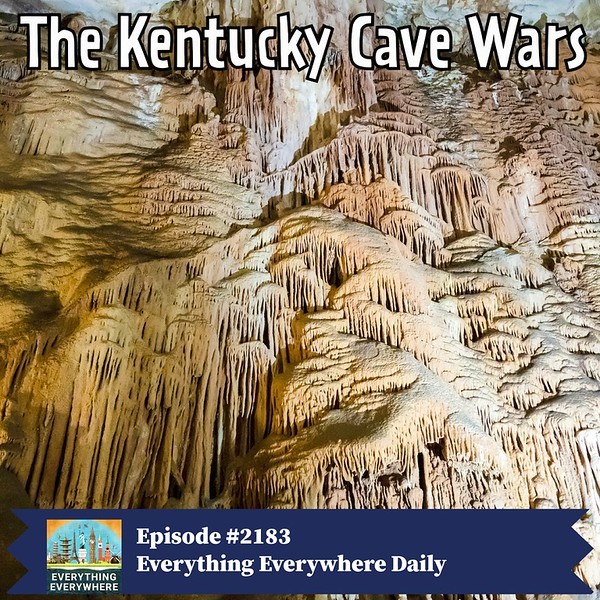
Dozens of “show caves” sprang up by the 19200s. Each owned by different families. Competition was savage. You didn’t just find a hole. You found flair. Stalactites. Stalagmites. Mineral deposits. Visuals sold tickets.
Location mattered. If you weren’t near a railroad station you were invisible. Until cars changed everything. The automobile freed operators from tracks. Sudden accessibility. Any cave within driving range could compete.
But tourists wanted prestige. They wanted The Cave.
Here was the loophole. Mammoth is connected to many other caves underground. If you could find an entrance in your yard that led into Mammoth you could sell a ticket to “Mammoth” without using the main door. You were tapping into the brand. Without paying royalties.
George Morrison figured this out.
He bribed a guide. Stole a map. Explored systematically. By 1926 he opened a second entrance to Mammoth from his property. He called it something distinct. He claimed the connection. The Kentucky Cave Wars were officially on.
Owners at the main Mammoth entrance panicked. This wasn’t fair competition. This was theft.
Enter the “cappers.”
Cappers were ticket sellers. Mercenaries. They stood on roads. They hijacked traffic. They were ruthless.
Methods were shady. Fake police officers told drivers Mammoth was closed due to quarantine. “Turn around,” they lied. “Go here instead.”
Fake tourists shouted compliments. “Oh my god the crystals at this cave are huge! Don’t go to the big one! It’s boring!”
Rumors flew. A fire in the main cave? A cave-in? Go to the competitor’s site. Safe. Exciting. Cheaper.
Extreme tactics emerged. Cappers threw rocks at tour boats coming down the river to stop them reaching Mammoth. They blocked roads. They burned down competitors’ ticket booths. Vandalism became strategy.
The legal system creaked under the pressure. Mammoth sued. Morrison countered. Confused tourists arrived at signs with identical names. “Crystal Cave,” “Crystal Cavern,” “New Crystal.” It was intentional. The ambiguity was the weapon.
Violence and Death
Words aren’t enough. Sometimes fists talk. Then guns.
1921 saw a shooting. Employees from rival caves argued. Someone died. It wasn’t an accident. It was business.
But the peak was darker. It involved a man named Floyd Collins.
Collins wanted glory. He owned Crystal Cave which had failed financially. He needed a win. He found a potential new spot: Sand Cave. He explored.
He got stuck.
His leg was pinned in a fissure. Too narrow to escape. Too wide to wiggle out. The news media arrived. Reporters filmed him. They mocked his plight. They packed into the tiny opening. Collins suffered for eighteen days. Cold. Hunger. Desperation. He died in the rock.
Did this make people stop digging?
No. It made them dig harder.
Tourists flocked to Sand Cave. Not for Collins’ grave initially. For the drama. Then came the grotesque marketing. The owners exhumed his body in 1937. Placed him in a glass coffin inside the cave. “Visit the Man Trapped in the Rock.”
It sold. Thousands bought tickets to stare at his remains. It was macabre. It was profitable. It was the height of the chaos.
The Endgame
Congress intervened. Sort of. In 1941 Mammoth Cave became a National Park. The government bought the land. They took ownership. They regulated access.
Did the fighting stop?
Not really. Private owners outside the park kept trying. They competed with the feds. Cross-promotions evolved. “Cappers” started working with the park to share profits rather than fight them.
The violent era faded through the 60s. Tourism standardized. Safety improved. The raw hustle calcified into brochures.
What does this tell us?
Humans will turn wonder into a product. We will bury friends, burn buildings, lie about quarantines for a piece of paper. Mammoth Cave stands now protected. Clean. Safe. The violence is gone. The memories linger.
Under the ground things stay. Above it changes.