


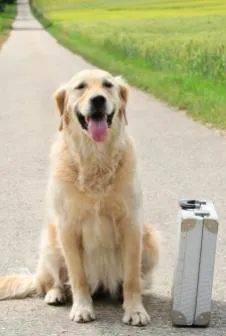
Animals seem to carry an internal compass that science still can’t fully decode. Salmon track chemical signatures to their birthstreams. Birds read the celestial map of sun and stars. But dogs and cats? They operate on something harder to define. We have stories, not explanations, for the animals that vanish and then reappear, often covering distances that should be impossible for them.
The 4,500-Mile Journey from Wisconsin to France
Take Emily, a one-year-old tabby in Appleton, Wisconsin. When she vanished from Lesley and Donny McElhiney’s home, the family thought the worst. They didn’t know she had boarded a truck heading for Chicago. Inside a container of paper bales, she was shipped across the Atlantic to Belgium, and then on to France.
She ended up at a laminating company, thin and dehydrated. Her tags saved her. A quick check led to Continental Airlines, who helped fly her back to her family. It was a 4,500-mile adventure she survived.
Crossing the Australian Outback
Not all returns are this fast. The Hicks family in Australia had to leave their Persian cat, Howie, with relatives over 1,000 miles away during a long vacation. When they returned a year later, the relatives said Howie had run away. They assumed an indoor cat wouldn’t survive the wild.
Their daughter came home from school one day to find a mangy, starving cat on the porch. It was Howie. He had spent 12 months traversing the Australian outback to get back. The journey took a year, but he made it.
A Notch on the Collar
The Doolen family moved from Aurora, Illinois, to East Lansing, Michigan, about 260 miles away. They gave their mixed-breed dog, Tony, to friends in the new town. Six weeks later, Tony trotted down the street in East Lansing and announced his arrival to Mr. Doolen.
How did he know? He recognized the street. And Mr. Doolen recognized a specific notch cut into Tony’s collar—a detail only the family knew.
The Finicky Cat Who Walked 150 Miles
Madonna, a seven-year-old tabby, wasn’t interested in the new life her owner, Nina, was building in Windsor, Ontario. They had moved from Kitchener to open a new branch of the family massage parlor business. Within weeks, Madonna vanished.
She didn’t go far in the sense of geography, but far enough. She ended up back at the original massage parlor in Kitchener, where Nina’s sister was now running the show. The total walking distance was about 150 miles. Madonna preferred her old routine.
A Scout Dog’s Mission in Vietnam
Troubles was a scout dog serving with William Richardson in South Vietnam during the late 1960s. Richardson was wounded by enemy fire and evacuated to a hospital. The rest of the unit left Troubles behind.
Three weeks later, Troubles appeared at the First Air Cavalry Division Headquarters in An Khe. He refused to let anyone near him. He was on a mission. He searched the tents until he found Richardson’s clothes, used them as a bed, and finally curled up. He had found his handler’s scent, even if the handler wasn’t there.
The Hospital Visit
Misele, a farm cat, belongs to 82-year-old Alfonse Mondry in France. When Mondry was hospitalized, Misele missed him. She walked across cattle fields, rock quarries, forests, and busy highways to find him. She had never been to the hospital before.
She entered the building and walked straight to Mondry’s room. The nurses called the doctor when they saw the old man resting comfortably with his cat purring on his lap. She knew the way.
Planning for the Unexpected
These stories are inspiring, but they are outliers. Most pets don’t have the map-making skills of Emily or Troubles. If you are planning a trip, whether you are driving cross-country or flying overseas, don’t rely on their sense of direction.
Use microchipping. It works. Check the local vets’ protocols before you leave. Keep tags on, but don’t expect them to do the heavy lifting like they did for Emily. If you are driving, look into pet-friendly hotels that don’t just tolerate animals but welcome them. Cities with good pet policies make the logistics easier.
The odds are against them finding their way back. Better to be safe.


