You might think you know Denmark. You can imagine the pastel facades of Copenhagen, but maybe with a bit of hygge. However, it would be a mistake to ignore Roskilde when planning your trip. Although it’s only a short train ride from the capital, it feels like you’ve stepped into another century. This is more than just a suburb. It is the historical center of the Danish monarchy and the resting place of the Vikings.
The city is located at the top of Roskilde Fjord in East Zealand. According to legend, it was founded by Hroar. The name comes from his name plus kilde meaning sacred springs. There is also a spring nearby. Although they are silent now, they point to a past when this place was a spiritual place long before it became a political place.
It was the capital of Denmark for almost four centuries. Kings ruled here from about 1020-1416. In 1443, the center of power moved to Copenhagen, but its legacy remained. It is also the center of the church. The history of the diocese dates back to around 1060. Before the Reformation, Roskilde was the most important church center in the country. The Treaty of Roskilde with Sweden was also drawn up here in 1658. This treaty changed the map of Scandinavia.
Today, cities are defined by their connections. New Zealand’s largest rail hub. The first Danish railway connected it to Copenhagen in 1847. This one line changed everything. Today, the city is located on the main route connecting Sweden and Germany via the Great Belt Bridge and the Sound Bridge. You’ll get here quickly. You can leave faster.
But it’s not just passing by. Stay and visit the cathedral.
Why Roskilde Cathedral is Non-Negotiable
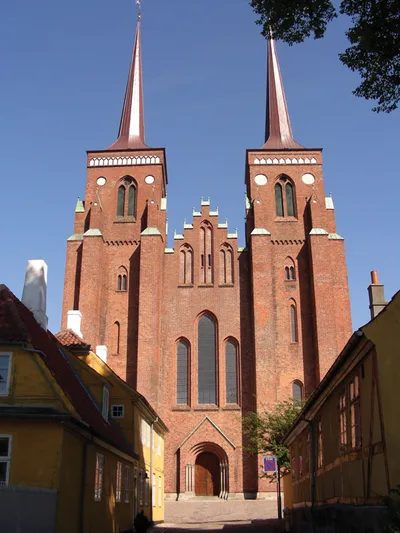
Roskilde Cathedral is half Romanesque and half Gothic. Bishop Absalon started building this church around 1170. This church was consecrated much later, in 1464. This church stands on the site of two earlier churches.
This is more than just a beautiful building. This is a royal tomb. 38 Danish kings and queens are buried here. From the Reformation until 1972, 16 of them… lie in an unbroken line. You can walk past the tombs of the rulers who shaped the history of this country.
“The cathedral is a royal mausoleum where 38 Danish kings and queens are buried.”
It anchors the city. It gives Roskilde a gravity that other towns lack. You can feel it when you approach a brick wall. You can feel it in the silence of the nave.
Viking Museum: Ships That Defied Time
If the cathedral shows the power of the monarchy, the Viking Museum shows the power of the sea. The Viking Museum was opened here in 1969. The museum has a 1,000-year-old longboats.
These are not models. These are real boats. They were dug up from the mud and brought here. They survived because the water was low in oxygen. They survived because someone cared enough to preserve them.
It shows the craftsmanship. clinker-built hulls. Symmetry. They are designed to cut through