Everyone knows the name Jackie Robinson. You say baseball, you say breaking the color line. It is the default answer. The easy one.
Ask who broke it in the American League.
Pause.
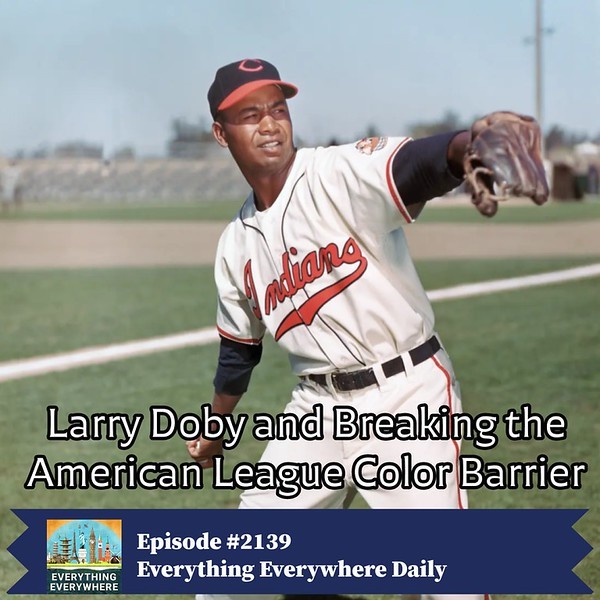
The silence stretches. That’s where Larry Doby lives. Seven-time All-Star. Two-time home run king. Hall of Famer. A pioneer who arrived not with a red carpet, but with a train ticket and a sink-or-swim mandate.
“The entrance of Negroes into the Majors… is not only inevitable. It’s here.”
That was Bill Veeck, the Cleveland Indians’ owner, in 1947. He wasn’t planning a decade-long grand experiment. He wasn’t looking for a civil rights leader in batting gear. He was looking for a win. Veeck saw the Negro Leagues as a goldmine of talent ignored by white MLB executives. He wanted the best players, regardless of race.
So he called Doby.
Jackie Robinson spent two years preparing. Branch Rickey trained him in patience. He knew the plan a year before stepping on a Major League field. Robinson was armored for the battle.
Doby got no armor.
One morning Doby expected to finish a doubleheader with the Newark Eagles. Then the phone rang. The Indians bought his contract. He played the first game anyway. Hit a home run to cap his Negro League career. Then he boarded a train for Chicago. Alone.
No minor league warm-up. No organizational safety net. He signed on July 4th. Debuted July 5th. Against the Chicago White Sox.
Thrust into the fire at 23 years old, Doby was younger than Robinson and possessed every tool the game demanded. Run, hit, field, throw. Plus power. Robinson was great. Doby was complete. But Veeck didn’t tell his manager. He didn’t warn his teammates.
The shock in the Indians’ locker room was visceral. Some players wouldn’t look at him. Others wouldn’t shake his hand. Lou Boudreau, the manager, thought the reports were a joke when they first hit.
On the field? Isolation.
“I felt all alone. No one asked me to play… I just stood there.”
Minutes ticked by. No teammate stepped in. Until Joe Gordon, an outfielder and former MVP, walked over.
“Hey kid,” Gordon said. “Come on. Throw with me.”
One gesture. That was all.
The hostility followed him on the road too. Jim Crow laws meant separate hotels. Separate restaurants. Solitude everywhere he went. Mel Harder, a teammate, noticed. Said Doby never complained. That was the hard part. Keeping quiet when every pitch came with venom.
Stats tell a different story for that first partial season. Robinson hit .297, stole bases, won Rookie of the Year. Doby played 29 games. Hit .156. No home runs. The pressure was suffocating. He knew it would be tough. He didn’t know it would be that tough.
Then 1948 arrived.
A full spring training changed everything. Doby adjusted. He hit .301. Fourteen homers. He won the World Series.
In Game 4, bottom of the third, Doby lifted one into the stands. The Indians took the lead 2-1. Pitcher Steve Gromek locked down the game. But the real moment wasn’t on the scoreboard. It was in the clubhouse.
A photographer from the Cleveland Plain Dealer captured Gromek and Doby embracing. Beaming. Just happy men who had just won.
Coast to coast, newspapers ran the photo. Americans saw a white man and a black man celebrating together. No tension. No politics. Just victory.
“It did more for human relationships than anything… One was white, one was black—and it didn’t make any difference.”
That picture outshone the iconic Robinson-Pee Wee Reese image because it showed the aftermath. Success. Shared joy. Integration working at its peak.
Doby kept winning. 1948 was special for another reason: Satchel Paige arrived. At 42, the pitching legend joined Cleveland. Finally, Doby had someone who understood the road. A mentor. A comrade.
After his playing days, the barriers didn’t stop. In 1978, Doby became the Chicago White Sox manager. Only the second Black skipper in MLB history, following Frank Robinson.
Later, he moved to the NBA as a coordinator for the New Jersey Nets, building programs for youth in New York City.
He died in 2003 from cancer, aged 79. A friend of his late neighbor, Yogi Berra, till the end.
In 1998, he entered the Hall of Fame. In 2023, the Congress awarded him the Gold Medal. Now there’s a push for July 5th to carry his number, 14, on every uniform, just like April 15 for Robinson.
Rob Manfred called him a pioneer of character and courage. Maybe so. Or maybe he was just a player who had no choice but to endure, while everyone else watched from the dugout.
History remembers the first one. But someone always had to be the second.