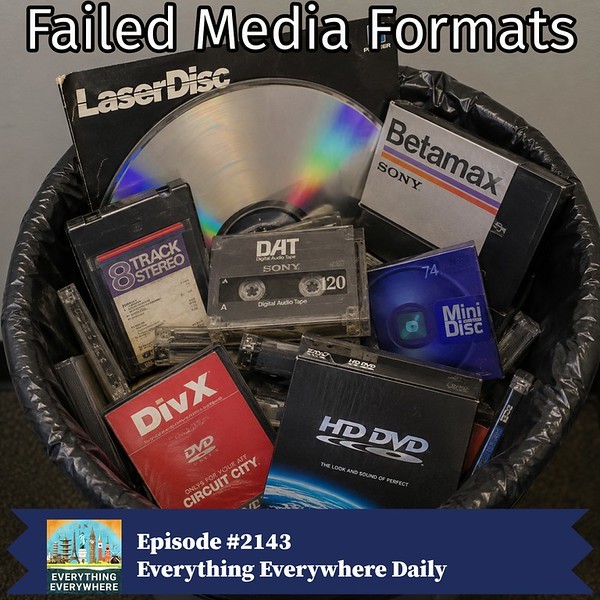
Listen to this. Companies have spent a hundred years trying to figure out how you store movies. Some bets paid off. Billions. Most others? Total waste.
There is a staggering number of formats that went nowhere. We remember the hits. Vinyl. Cassette. DVD. But the failures are louder if you know where to look.
This isn’t about data storage for computers. Just music. And video.
I am also ignoring anything that dominated its era. So no VHS. No Betamax (though I’ll touch on it). If it was king, even briefly, it doesn’t count here.
The Pre-Video Tapes
Start with Cartrivision. You have never heard of it. You should not have.
Introduced in 1972. Before VHS. Before Betamax. It was built directly into huge television sets. You could record TV shows. You could rent movies.
Rental. That was the model.
The system had a nasty trick. The rental tapes couldn’t be rewound at home. You watched it. You returned it. The tape locked.
The console cost the equivalent of $10,000 today. Bulky. Expensive. Dead in a year.
Here is the twist. In 2013 someone found the missing Game 5 of the 1 9 7 3 NBA Championship on one of these tapes. It took ages to recover the signal. They made a documentary about the effort.
A documentary about a format nobody remembers.
The 8-Track Struggle
The 8-track tape is infamous. It had its moment. It was huge in cars in the seventies.
It solved one specific problem: how do you play records in a moving car?
Reel-to-reels were messy. Tangled. Fragile. The 8-track was an endless loop of tape inside a plastic block. You shoved it into the dash. It played. Instantly.
Bill Lear of Learjet fame helped standardize it. Ford put it in cars. Everyone bought it.
But it was broken from day one.
The loop stretched. It tangled. The splice where the tracks joined was weak. Every song transition ended in a click or a static pop. Sometimes a song faded out. The machine clunked. The song faded back in.
Awkward.
Cassette tapes replaced it. They were smaller. Tougher. And then came the Sony Walkman, and 8-track vanished.
The Video Wars
Do not get me started on Betamax. I have covered the war between it and VHS before. The common wisdom is that Betamax was superior tech and lost due to corruption or conspiracy.
It’s simpler.
People wanted longer recording times. VHS offered two hours. Betamax offered one. People rented porn and sports highlights. VHS won.
During this war, RCA released SelectaVision. Or the CED (Capacitance Electronic Disc).
This was a disaster. A massive, expensive embarrassment.
It used vinyl-like discs read by a stylus. Yes. Like a record player. But for video.
The discs lived in protective caddies. You inserted the plastic case. The player sucked the disc out. The empty caddy spitted back out. Clever engineering? Maybe.
Bad business. Terrible timing.
RCA spent twelve years developing this. They launched in 1 9 8 1. VHS was already everywhere. Betamax was established.
SelectaVision couldn’t record TV. You could only watch movies. In an era when “time-shifting” recording live sports or sitcoms was the main draw of video players, RCA offered playback only.
It worked. The quality was decent for the tech. But it arrived three years too late to save the company. RCA lost hundreds of millions.
Classic case of solving a problem that nobody had anymore.
The Optical Almost-Successes
LaserDisc was beautiful. Big 12-inch optical discs. Analog video read by laser.
It was the ancestor of DVD.
The quality crushed VHS. Sharper image. Stereo sound. Director commentaries. Bonus tracks. If you loved movies. If you cared. LaserDisc was the format.
It never became mainstream. Too big. Too fragile. But for collectors. It was the gold standard.
Then came digital audio. DAT. Digital Audio Tape.
Sony launched it in the eighties. High fidelity. Digital sound in a tiny cartridge.
Engineers loved it. Recording studios used it everywhere. It was clean. Durable.
The record labels hated it.
Why? Perfect copying. DAT could digitize CDs without any quality loss. Panic. Lawsuits. Restrictions.
They installed Serial Copy Management systems. Digital rights management before the internet made it mandatory. The cost of the players remained high. Regular consumers stuck to CDs or cassettes.
Sony tried again. MiniDisc.
Early nineties. Small plastic cartridge with a magneto-optical disc inside. Recordable. Erasable. Durable.
It was exactly what cassettes wanted to be.
Journalists loved it. Musicians used it for demos. In Japan. It was everywhere.
But globally. It was trapped. CDs were cheap. Then MP3s arrived. Suddenly carrying physical plastic discs felt ancient.
Sony made the same mistake again. Restrictive copy protection. Dragging MP3s onto a flash drive is easier than managing tracks on a MiniDisc.
Not a bad product. Just born at the wrong time. Caught between the cassette and the iPod.
The Audiophile’s Ghost Town
What about sound better than CD?
Two formats emerged. Both failed to kill the CD.
First, DVD-Audio.
Higher bit rates. 24-bit. Surround sound mixes. Stored on DVD media.
I bought some back in 2 0 0 0. Do you need a new speaker system to hear the difference? Maybe. I still play them on my Blu-ray player. It works.
Then SACD. Super Audio CD.
Created by Philips and Sony. Their own invention turned against their CD legacy.
SACD used a single-bit stream sampled at over 2.8 million times a second. Instead of 1s and 0s representing binary steps, they represented direct voltage pulses. DSD. Direct Stream Digital.
Complex. Niche.
Here is why both failed.
Timing.
DVD-Audio and SACD launched when Napster peaked. MP3s exploded. Nobody cared about higher bit rates. They cared about portability.
Convenience won. Always.
Still Spinning?
Physical media is not dead. Just different.
Sales have ticked up. People are tired of streaming services pulling songs or movies overnight.
You want your library. Forever.
Even 8-track is having a weird revival. Enthusiasts are pressing new tapes. Reel-to-reel has a following again.
Will there be a new format?
Unlikely. The market is too small. The technology is settled.
We have our archives. We have our nostalgia. That is enough for now.