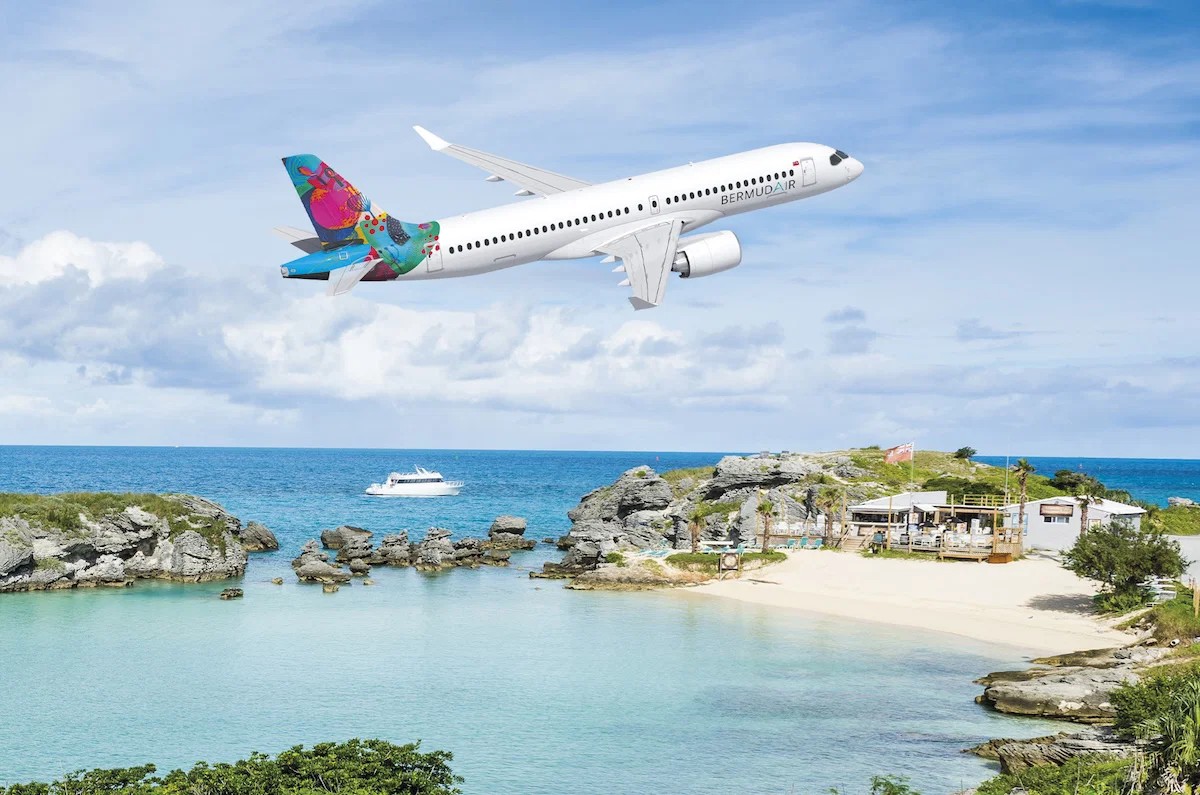
BermudAir is expanding. The airline, which has spent years struggling to define its identity, has announced an order for up to twenty Airbus A220-30s. That’s a massive pivot for a carrier currently running on a shoestring fleet of four used Embraer jets.
It’s bold. It’s also deeply suspicious.
I have to ask: Is this rational growth or desperate overreach?
The A220 Order: From Four Jets to Twenty
Here are the hard facts. BermudAir isn’t just talking about one or two new planes. The carrier disclosed that an affiliated entity, Odyssey, placed the order in March 2026 (with deliveries starting late 2027). The plan is to acquire ten Airbus A220-30300s immediately, with options to expand the fleet to twenty by 20303.
To put that in perspective, the airline currently operates four used Embraer E-Jets. Two E175s. Two E190s.
They are swapping a handful of older, likely depreciated aircraft for a wall of brand-new, high-tech planes. That is a capital-intensive leap.
The new configuration? Three classes. One hundred thirty-five seats. You’ve got business, extra-legroom economy, and standard economy. It’s a premium product play in a market that’s been brutally squeezed by inflation and fatigue.
“The A220 is the ideal aircraft… Its exceptional range… will allow us to connect more communities.”
— Adam Scott, CEO of BermudAir
Scott argues that the A220’s ability to handle constrained airports—shorter runways, tighter terminals—makes it perfect for their network. He’s right about the plane’s capabilities. The question is whether the demand exists to fill 135 seats on routes that don’t have competing airlines.
Where Are They Flying?
The stated strategy for the Airbus A220 fleet expansion is to open “nonstop, non-competitive routes” across the Atlantic. This includes Bermuda, the Caribbean, Central America, and parts of North America.
But let’s look at what they’re actually doing.
BermudAir started with a very specific, somewhat odd concept: Odyssey Airlines. It was supposed to be an all-business class shuttle between London City Airport and North America on the Bombardier CS100 (the original name for the A220). That project died.
Then, they pivoted to focusing almost entirely on Bermuda. That didn’t scale well. So now they are scattering routes across the region.
- Baltimore (BWI) to Anguila (AXA)
- Raleigh (RDU) to Belize (BZE)
- St. Petersburg (PIE) to St. George’s, Grenada or similar Caribbean spots
These aren’t traditional high-density business corridors. They are niche routes. They require specific timing. And they require a plane that can fly them efficiently. The A220 can. Can the passengers show up?
The Red Flags
I’ve covered startup airlines long enough to recognize the smell of a bad business model before the first engine even starts.
BermudAir has a history of flipping-flopping on its core strategy.
- The Class Confusion: They started with an all-business model, then backed down. Why? Probably because they couldn’t fill the seats.
- The Geographic Whiplash: They went from “only Bermuda” to “anywhere with a runway and a dream.”
- The Debt Question: There was a very public dispute with Bermuda Airport over millions in unpaid fees. That doesn’t inspire confidence in cash flow management.
Is this a savvy move to dominate niche markets? Maybe. But it feels more like throwing spaghetti at the wall to see if anything sticks. The “vibes” are desperate.
The Cost Problem
The Airbus A220 is a marvel of modern aviation engineering. It’s quiet. It’s comfortable. It has excellent operating economics compared to older narrowbodies.
But it’s new.
Buying twenty new planes is exponentially more expensive than acquiring four used Embraers. Used Embraers are cheap. They’re affordable because airlines have moved on to newer tech. The A220 commands a premium.
Can BermudAir find enough passengers on these specific, scattered routes to pay off a twenty-plane fleet of new aircraft?
Most analysts would say no. Regional carriers struggle to sustain profitability on thin routes without significant subsidies or dense trunk lines to feed them. BermudAir has no trunk lines. It has a collection of specks on a map.
Bottom Line
This order changes everything for BermudAir. It raises their overhead, their exposure, and their expectations.
Going from four used jets to twenty new A220s is not a gradual expansion. It’s a bet the house.
If the passengers show up, BermudAir becomes a respected regional player. If they don’t, they’re left with high debt and empty seats on planes designed for longer, denser routes.
I don’t know what to think of this operation. I love seeing new airlines succeed. But I love not watching them go under even more.
Keep your eyes on the load factors. If those A220s aren’t flying 80% full by mid-2028, this whole expansion was a mistake.
And honestly? I’m betting on the latter.