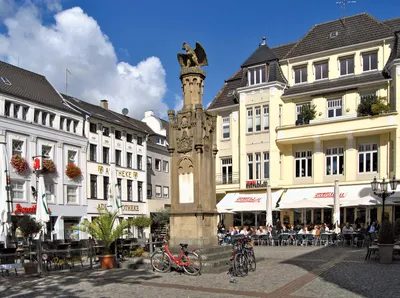
Forget the postcard-perfect villages in the Black Forest. If you want to understand the real industrial heart of western Germany, you need to look at Moers. Tucked immediately west of Duisburg in the North Rhine-Westphalia state, this city sits squarely in the Ruhr industrial region. It is not a destination for lazy beach days, but for travelers who want to walk through 1,000 years of history while smelling the faint ghost of coal mines.
How Moers Became a Fortress of Trade and Power
Moers was not always a factory town. Long before the smokestacks rose, the site was a Roman settlement known as Asciburgium. The first written mention of the modern name comes from the 9th century, when it grew around the castle of the counts of Moers. You can still visit that castle today, now converted into a museum that explains how a medieval flax market turned into a serious economic hub.
The city got its charter around 1300, but its destiny truly shifted in 1601. That is when Maurice of Nassau, prince of Orange, took ownership and fortified the place. He did not build a fairy-tale rampart. He built a defensive perimeter. By 1712, the city passed to Prussia, setting the stage for its later industrial explosion in the early 20th century as a center for coal and salt mining.
Which Walls Should You Walk?
The old town is partly ringed by a fortification wall that stretches 3 kilometers (about 2 miles). This is not a ruin you have to imagine. The wall is accompanied by a moat and a star-shaped dam. Walking this perimeter is one of the most concrete ways to grasp the military logic of the 17th century. The defensive architecture tells you exactly how seriously the Nassau princes took threats from the east.
The star-shaped dam is the key detail. It is not decorative. It was engineering.
Why Moers Matters to Modern Travelers
The heavy industry that defined the early 1900s has evolved. Today, Moers manufactures machinery, construction materials, paper, textiles, and food products. It is a working city, not just a museum. With a population of roughly 107,903 people (2003 estimate), it offers the scale of a mid-sized German town without the overwhelming crowds of Cologne or Düsseldorf.
For the practical traveler, Moers offers technical schools and a deep educational tradition. The Gymnasium Adolfinum continues a lineage that goes back to a Protestant college founded in 1582. This intellectual history blends with the industrial past to create a unique cultural texture. You are not just seeing buildings. You are seeing a place that reinvented itself from a flax market to a mining hub to a modern manufacturing center.
Where to Focus Your Time
If you have a day in Moers, start at the castle museum to understand the medieval origins. Then walk the fortification wall to feel the physical boundaries of the old town. The proximity to Duisburg means you are close to major transport links, making Moers a strategic base for exploring the wider Ruhr region. It is quiet enough to think, loud enough to