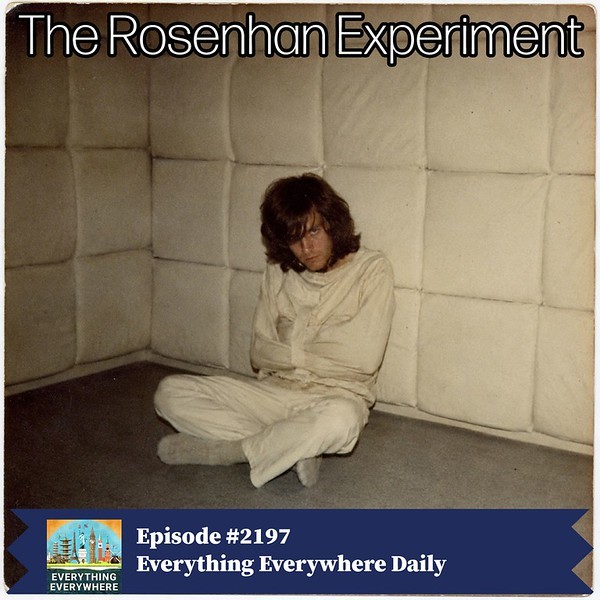
Imagine you are perfectly sane. You have a job, friends, a cat that judges you. One day, you wake up in a padded cell. You are locked in. You are insane.
At least, the paperwork says so.
David Rosenhan thought this nightmare scenario wasn’t just possible. He wanted to see how easily a normal person could get stuck. In 1973. It changed psychiatry forever. Or maybe it broke it first.
Rosenhan was a professor. Stanford. Psychology and Law. He wrote eighty-plus papers. But this one? The 1973 piece? It is the only thing he is famous for today. He believed psychiatric diagnosis was broken. Biased. Blind to the patient and obsessed with the label.
“On Being Sane in Insane places”
That is the title. It sounds like a philosophy lesson. It was an infiltration mission.
He recruited eight volunteers. Students. Totally healthy people. He sent them to twelve different mental hospitals across the US. They were called pseudopatients. Fake patients. Real people faking sick.
The trick was simple. Too simple.
Each impostor walked up to an admission ward. They complained of one symptom. Just one. They said they heard voices. Words like hollow. Empty. Thud. After that, they lied to no one else. They paid bills. They answered questions honestly. They acted like boring, normal humans.
They were all admitted.
Not some. All of them.
This was the first shock. A complaint about auditory hallucinations wasn’t enough for a sane person in the real world, but inside these walls, it was a ticket in.
Once inside, they stopped faking the voices. They claimed they never heard them again. They filled out forms. They wrote notes. They behaved exactly like you or me.
Did the doctors notice?
No.
Staff spent six minutes with these “patients” a day. Six. They stood behind glass. They ignored questions. They acted authoritarian. Cold. Distant.
The patients reported feeling bored. Invisible. Powerless. When the pseudopatients paced their rooms because time moved like syrup, staff noted “agitated behavior.” When they wrote diaries to record treatment, staff called it “formation of delusion.”
It is a self-fulfilling prophecy. If you think someone is crazy, you see madness in their silence. In their stillness.
They were kept for 7 to 53 days. Average? Nineteen days.
They were released, technically. But not cleared. Most left with a diagnosis of schizophrenia. Specifically: Schizophrenia in remission.
What does that mean?
It means you are still schizophrenic. You are just hiding it well. The label stuck. Even though the symptom that got them in vanished immediately, the system refused to let go of the diagnosis.
Here is the irony.
The hospital staff didn’t see the trick. The real patients did.
Several other inmates approached the pseudopatients. “You are journalists,” they said. “Or professors.” Why? Because the impostors took notes. Because they didn’t fit the profile of someone who truly believed the voices were real. The patients, the “insane,” saw through the charade. The staff did not.
Rosenhan ran a follow-up.
He warned a hospital that spies would infiltrate the ward. He told doctors to rate every patient from 1 to 10 on sanity. If a doctor rated a patient 1 or 2, they believed they were sane impostors.
41 out of 193 patients got those scores. 21 percent of the real patients were labeled fakers.
Rosenhan then revealed the truth.
There were no spies. No one came.
The doctors were so biased toward finding fakers that they mislabeled genuinely sick people. They projected fear onto the vulnerable.
It caused chaos. In a good way, maybe.
Before this, the Diagnostic and Statistical Manual of Mental Disorders (DSM) relied on doctors’ intuition. Vague. Unreliable. After Rosenhan, the DSM-3 introduced strict checklists. You need symptoms X, Y, and Z. For duration A. Otherwise, it doesn’t count.
It stripped the power from the individual psychiatrist’s gut feeling. It forced precision. It led to deinstitutionalization. Closing the big, sad farms of care. Moving people into communities.
Was it perfect?
No. It’s never perfect.
Psychiatrists hated the experiment. They argued it was invalid. They said Rosenhan cheated by lying. One critic said it’s like drinking a gallon of blood, going to the ER, and complaining about nausea. If you lie, the diagnosis will be wrong. Of course. Doctors rely on self-report. If the patient is lying, the data is corrupted.
But is a patient with schizophrenia “lying”? No. They are experiencing reality differently. The system must account for that difference, not assume deception.
Fast forward fifty years.
A new book drops in 2019. The Great Pretender. Author Susannah Cahalan.
She looks at the files. The documents. She finds inconsistencies. She cannot find records for six of the eight pseudopatients. Only Rosenhan and one graduate student show up as verifiable participants.
Did Rosenhan fabricate the others?
The History of Psychology journal agreed. They think the data might be cooked. The experiment might be a hoax. A grand fabrication designed to force change through scandal rather than science.
Does it matter?
Cahalan was misdiagnosed herself. That’s why she dug into this. She needed answers.
If Rosenhan made up the data, does the lesson vanish?
The label “schizophrenia” still warps perception. Doctors still miss the humanity in patients. The DSM checklists still feel rigid and cold.
The system has improved. But have we actually solved the bias? Or do we just hide it behind more forms?
We like our boxes. Our categories. But humans don’t fit in them.
So. What now?
If the experiment was a lie, we were tricked by truth.