It shouldn’t be here. A post-industrial mining town, slowly picking itself up after coal disappeared entirely? Not the spot you hunt for world-class culture. But Wakefield did something unexpected. It built a temple for abstract sculpture right where its famous daughter started.
The Artist Behind the Stone
Barbara Hepworth. You probably know the name, maybe even a shape. She was born there in 1903, right in Yorkshire. She studied at the Leeds School of Art, rubbing shoulders with Henry Moore. They were close. Very close.
People think Moore invented the pierced form. They’re wrong. Hepworth did. It’s her signature—holes in solid matter, letting light through, making the negative space matter just as much as the stone or bronze itself. Moore liked it enough to copy it, history has it seems forgotten that it originated in her hands. Her most famous piece isn’t in Wakefield either. It stands outside the United Nations in New York, a memorial to Dag Hammarssjöld. A friend. A leader. Gone. The sculpture remembers him.
Chipperfield’s Box
David Chipperfield designed the building. 2011, it opened.
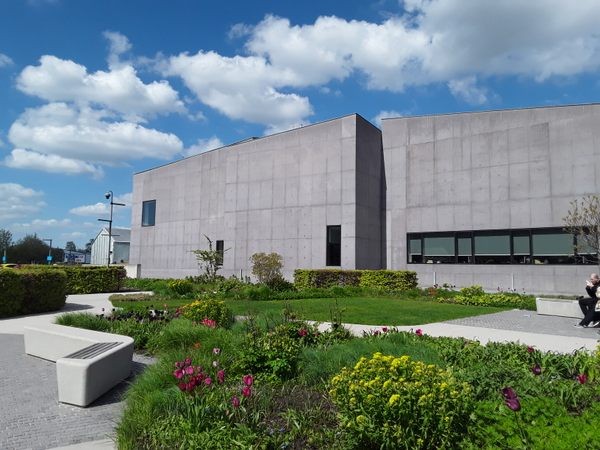
Concrete. Trapezoid. Sharp angles cutting into the landscape. One side of the museum dips its toes into the River Calder. Literally. The structure meets the water at the weir. It feels intentional, almost like the building is drinking. Across the road sits the Chantry Chapel, an ancient contrast to this modern monolith. To the south, old brick industrial buildings—former mills now housing creative workers—provide a rough, warm backdrop to the museum’s cool geometry. It clashes. Beautifully.
“The collection is not just for looking, it is for understanding how art is made.”
They call it a museum, not a gallery. Deliberately. Because the curators care about process. The how, not just the what. You learn about the making.
More Than Just Hepworth
Walk inside and you see LS Lowry’s matchstick figures. David Hockney’s bold lines. Henry Moore’s forms, still there, still resonating. Ronald Moody adds his quiet presence to the mix. Then there are the changing exhibitions, rotating the city’s own art collection in and out. A small sculpture garden waits outside, letting the work breathe in the air.
Why not drive the seven miles southwest to the Yorkshire Sculpture Park? Sure, you can. The sculptures there are larger, outdoors, wilder. But this? This is intimate. Precise. If you’re in a car, tack it onto your itinerary. Easy enough.
Stop by the Chantry Bridge while you’re at it. It frames the river nicely. The view is nice too. But the real story is inside the concrete walls.