United Airlines has a new product for you.
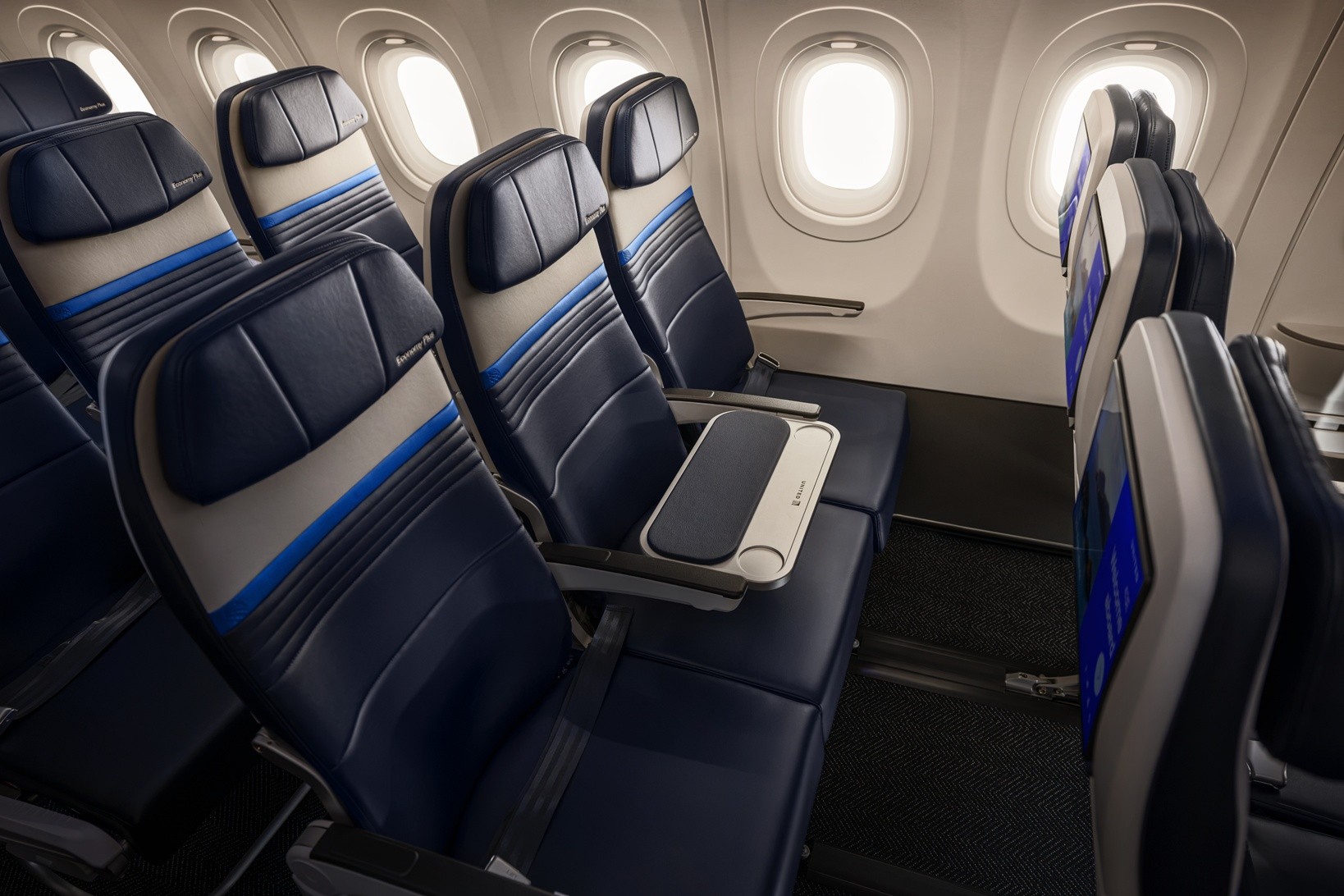
It’s called ‘European Business Class,’ but don’t get too excited about the name. That’s marketing speak for “Economy Plus Seats With Extra Elbow Space.” Available soon on their new Airbus A321XLRs. You pay more. You get a shared table in front of a blocked middle seat.
It sounds fancy until you read the fine print.
It is exactly the same seat as everyone else. The cushion isn’t wider. The pitch isn’t longer. They just slapped a plastic tray over the middle cushion so you can’t sit there. Why? Because blocking a seat saves money.
The Math Of Comfort
Let’s talk numbers.
United plans to fit 150 passengers on this bird. Not 149. Not 151. One hundred fifty. Why?
Federal regulations. 14 CFR § 121.391 says that if you have more than 100 seats you need two flight attendants. Then you add one more attendant for every extra 50 seats above that threshold.
150 seats equals three attendants for the cabin, plus one more required by the business class door configuration. That is four crew members.
If you add one seat—making it 151—the math changes. You need five attendants now.
United knows this. So they blocked two middle seats. This drops the count from a hypothetical 152 down to 150. They stay within the four-attendant limit. They save a salary. But they also created a premium product out of nothing. They call it ingenuity. I call it a hack.
“United is monetizing a cost-cutting move by charging for empty air.”
Does it work? Sort of.
You get the aisle-side luxury without the business class ticket price. You also don’t get lounge access or free booze. You’re still in coach. You just have an extra eight inches of elbow room. Is it worth the markup? You be the judge.
Who Did It Before?
This isn’t new.
American Airlines did this on 737s years ago. Back before US Airways management took over, AA had 154 seats. Four middles were blacked out. Why? To keep the attendant count down. US Airways looked at that, laughed, and added the seats back in. They went to 172 seats eventually.
Frontier does it. Spirit did it with their ‘Go Comfy’ rows. Even United used to leave middle seats empty for elite flyers. Back in the day, 2007 maybe? Those were golden times. We didn’t count seats for regulatory tricks then. We did it because elites existed and had power.
Now the power is in the spreadsheet.
The A321XLR Strategy
Here is the thing about the Airbus A321XSR. It’s a long-haul jet disguised as a short-haul one.
United is pulling the old Boeing 757 out of retirement routes. The 757 is aging. It struggles with headwinds when flying home to the US from Europe or Brazil in winter. The XLR has better range. Better efficiency.
They are testing this in places like Newark to Paris. Dulles to Lisbon. Thin routes where a big widebody bleeds money. A 787 costs more to park. It burns more fuel on empty seats.
So they shrink the plane.
The natural layout of this cabin puts 20 people in business, 12 in premium eco. That leaves 152 in coach. Five attendants. Too many. Block two middles. Four attendants. Profit.
Will this come to other planes? Maybe. United is “exploring” it. But other airframes don’t have the same mathematical cliff. If you aren’t balancing on the edge of a federal staffing requirement, the table doesn’t save you money. It just looks nice.
What comes next
United loves a gimmick. Next year they want rows of coach seats that turn into beds. A “Relax Row.” Copying Air New Zealand’s Sky Couch. It adds complexity to a system that barely holds together as it is.
For now, enjoy the table.
Enjoy the elbow room. Just remember it wasn’t designed for you. It was designed to keep a flight attendant off the payroll.